Evaluation of gender variation in health awareness of Adolescent age groups in rural India
Introduction
World Health Organization (WHO) defines adolescence as the period between 10 and 19 years of age. During this period, they have to face a lot of changes which may include physical, mental, emotional or psychological changes. Yet they are the once whose health is neglected the most, especially that of female adolescent group. [1]
Health awareness not only includes the awareness for infections, diseases or disorders but also health related topics like physiological changes, psychological changes, hormonal changes, importance of exercise to stay fit, time for entertainment to stay active and happy etc. Adolescents in rural areas are often devoid of health care facilities and tends to fall sick more often. Both genders faces different types of problems. They even get addicted to un-healthy activities due to lack of awareness and peer pressure. Government of India has implemented many schemes for the spread of health awareness, but due to unknown reasons, it is not yet uniform among both the genders.
If they are aware of health issues surrounding them, they can fight or prevent them and can improve their lives. Females health has been always neglected in rural India and now as to be prioritised because not only they support family by sharing the economic burden but they also take care of the entire family. In order to share all responsibilities both males and females have to be fit and that should start from the very beginning, right after birth.
With implementation of new schemes and involvement of latest technology like internet; health awareness is improving[2] The teachers also teach them the benefits of health exercise and the requirement of time for recreational activities so that they can live a happy life.
Various studies and survey have been conducted before but none showed the difference of health awareness between males and females of adolescent group. So we conducted this study to access the gender variation in health awareness in adolescent age group [15-19 years].
Their answers to the questionnaire can help us to understand the awareness of health in rural areas and we could bring further changes or implement new plans for spreading health awareness especially if one of the gender is lacking behind in one area.
Material and Methods
The present study was conducted as a cross-sectional study in September, 2014 at a local school in Nhava village, Raigad District in Maharashtra State, India. A well-structured questionnaire was distributed randomly to 102 high school students which included 60 males and 42 females between 15 to 19 to evaluate gender variation in health awareness and attitude towards awareness of side effects of tobacco consumption leading to oral or lung cancer, Sexually Transmitted Diseases (STD) and its transmission route, reaction on stress situations, knowledge of body mass index and ill effects of being malnourished, importance of having breakfast and in between meals with time for exercise and recreational activities, evaluating depression by asking mood changes. Their family type, number of members and average family income, per capita income were also found out. They were asked if they suffered from any other disorders or diseases.
The required official permission to select and collect the relevant data from selected subjects was solicited and obtained from the Principal of the respective school. There were 13 questions and the questionnaire was collected on the spot from participants after explaining them the importance of study and obtaining their oral consent. Writing names on the form was optional and was informed that their identity will be kept hidden in all ways possible if they chose to write their names. The survey was carried out in their school timings and free periods.
Inclusion Criteria
- All Students between 15-19 years
Exclusion Criteria
- Students out of target i.e. above 20 years of age and below 15 years
- Who did not wanted to be a part of the survey
Statistical analysis
The data were entered into the computer (Microsoft Office, Excel) and were subjected to statistical analysis using the statistical package SPSS version 19.
Results
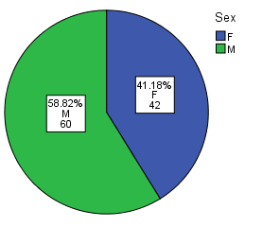
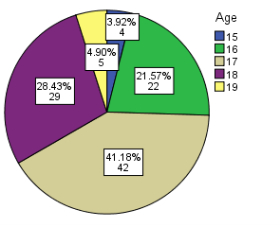
In the present study, we got 102 samples out of which 60 were males and 42 were females having 41.18 percentage of females and 58.82% of males. Also the ages ranged from 15-19. Most number of the students were in 17th year.
-
Breakfast Everyday & In between meals 2-3 hours (Table 1)
Here we noticed that only 69% Females said that they were able to have breakfast as compared to 81.7% Males. Values are given in Table 1.
n=Number, %= percentage
|
Sex |
Breakfast everyday & In between meals every 2-3 hours |
||||||||
|
Yes |
Not able to have |
Total |
|||||||
|
N |
% |
N |
% |
n |
% |
||||
|
F |
29 |
69.0 |
13 |
31.0 |
42 |
100.0 |
|||
|
M |
49 |
81.7 |
11 |
18.3 |
60 |
100.0 |
|||
|
Total |
78 |
76.5 |
24 |
23.5 |
102 |
100.0 |
|||
Table 1
-
Time for Exercise & Recreation ( Table 2)
We noticed that 57.1% females here just said that they are able to do exercise and spare some time for recreation as compared to 80% approval from the males regarding the same.
|
Sex |
Time for exercise and recreation |
||||||||
|
Yes |
No |
Total |
|||||||
|
N |
% |
n |
% |
n |
% |
||||
|
F |
24 |
57.1 |
18 |
42.9 |
42 |
100.0 |
|||
|
M |
48 |
80.0 |
12 |
20.0 |
60 |
100.0 |
|||
|
Total |
72 |
70.6 |
30 |
29.4 |
102 |
100.0 |
|||
(Table 2)
-
Consume Tobacco in any form or any other substance abuse (Table 3)
It is interesting to see that only 5 males used to consume tobacco in cigarettes form which is 4.90%. Females denied taking any tobacco in any form. The values are depicted in table 3
|
Sex |
Consume tobacco in any form or any other substance abuse |
||||||||
|
Yes |
No |
Total |
|||||||
|
N |
% |
n |
% |
n |
% |
||||
|
F |
0 |
.0 |
42 |
100.0 |
42 |
100.0 |
|||
|
M |
5 |
8.3 |
55 |
91.7 |
60 |
100.0 |
|||
|
Total |
5 |
4.90 |
97 |
85.10 |
102 |
100.0 |
|||
Table 3
-
Awareness of the side effects of taking Tobacco in any form (Table 4)
Here we noticed that Females are more aware of the side effects of taking tobacco. Their awareness rate is 95.2% as compared to 78.3% of Males. The values are depicted in table 4.
|
Sex |
Awareness of side effects regarding tobacco & Substance abuse |
||||||||
|
Yes (Aware) |
No |
Total |
|||||||
|
N |
% |
n |
% |
n |
% |
||||
|
F |
40 |
95.2 |
2 |
4.8 |
42 |
100.0 |
|||
|
M |
47 |
78.3 |
13 |
21.7 |
60 |
100.0 |
|||
|
Total |
87 |
85.3 |
15 |
14.7 |
102 |
100.0 |
|||
Table 4
-
Awareness of STDs & at least one route of spread (Table 5)
Mostly everyone knows about STD and its of route of spread. More details are depicted in table 5.
|
Sex |
Awareness of STD |
||||||||
|
Yes |
No |
Total |
|||||||
|
N |
% |
n |
% |
n |
% |
||||
|
F |
42 |
100.0 |
0 |
.0 |
42 |
100.0 |
|||
|
M |
58 |
98.04 |
2 |
1.96 |
60 |
100.0 |
|||
|
Total |
100 |
98.04 |
2 |
1.96 |
102 |
100.0 |
|||
Table 5
-
BMI Status & Awareness to ill effects of malnourishment (Table 6-8)
BMI of the study subject was calculated by using the formula weight (kg)/ height2 (m2). For grading proposed criteria of BMI for Asians (Choo V 2002) and CDC (2010) was adopted.
We noticed that females tend to be more underweight as compared to males. Males being more prone to obesity at this age. The mean BMI for females was 20.41
|
Sex |
BMI Status |
||||||||||||||
|
Normal |
Obese |
Over Weight |
Underweight |
Total |
|||||||||||
|
N |
% |
N |
% |
n |
% |
n |
% |
n |
% |
||||||
|
F |
29 |
69.0 |
0 |
.0 |
1 |
2.4 |
12 |
28.6 |
42 |
100.0 |
|||||
|
M |
42 |
70.0 |
1 |
1.7 |
2 |
3.3 |
15 |
25.0 |
60 |
100.0 |
|||||
|
Total |
71 |
69.6 |
1 |
0.98 |
3 |
2.94 |
27 |
26.47 |
102 |
100.0 |
|||||
Table 6
|
Sex |
Statistic |
Std. Error |
|||
|
BMI |
F |
Mean |
20.417341 |
.4574878 |
|
|
95% Confidence Interval for Mean |
Lower Bound |
19.493425 |
|||
|
Upper Bound |
21.341256 |
||||
|
Std. Deviation |
2.9648599 |
||||
|
Minimum |
15.0597 |
||||
|
Maximum |
26.3146 |
||||
|
M |
Mean
Categories:
| ||||
